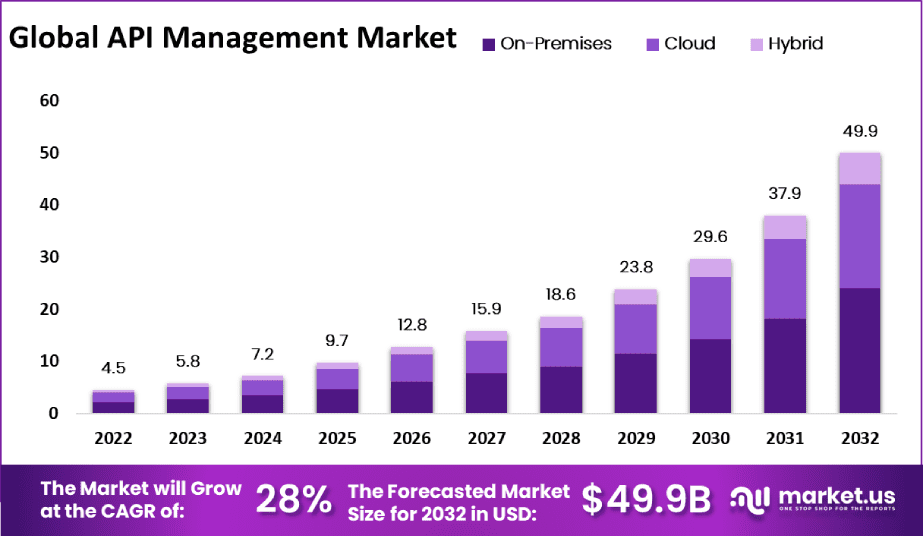
According to market.us, the latest API Management Market Analysis, in 2022, the Global API Management Market size was valued at US$ 4.5 billion. Between 2023 and 2032, this market is estimated to register the highest CAGR of 28%.
Full market insight:-https://market.us/report/api-management-market/
Market Trends
The API management market is witnessing significant expansion due to increasing adoption by businesses of all sizes. APIs play a central role in digital transformation and innovation for modern organizations; APIs connect their applications, systems, data services to external partners as well as developers for external access and service provisioning.
One of the key trends in API management market is moving toward cloud-based solutions, especially API management platforms like ServiceNow that offer various advantages like scalability, flexibility, and user friendliness. More organizations are opting to deploy their API management solutions via this route than before.
One key trend in software development today is the rise of API-first development, an approach which emphasizes designing and creating APIs first before building applications or services on top of them. This method brings many benefits including increased agility, flexibility and scalability.
Market Drivers
Businesses of All Sizes Adopt APIs as Essential Component of Digital Strategy: APIs have become indispensable tools in today's competitive digital environment, serving to connect applications and systems together as well as expose data or services externally for partner integration or developer usage, thus opening the way to new digital business models and opening opportunities for expansion.
Make the switch to cloud-based API management solutions: Cloud-based API management solutions offer many advantages over on-premises ones, including greater scalability, flexibility and user friendliness compared to their on-premises equivalents; as such more organizations are opting for this deployment option when it comes to API management solutions.
Increased Adoption of API-First Development: API-first development refers to a software development methodology which emphasizes designing and creating APIs before building applications or services on them, leading to enhanced agility, flexibility, and scalability benefits for enterprises. This method has proven its worth over time with increasing adoption by numerous businesses worldwide.
Demands for digital transformation and innovation: Businesses across industries face increasing pressure to digitally transform and innovate to remain competitive, and APIs play a vital role in driving this transition and innovation by connecting applications and systems, sharing data with external partners such as developers and creating new digital business models.
Rising demand for data sharing and collaboration: Businesses are sharing and collaborating more frequently with partners and developers in order to develop innovative new products and services, leading them to use APIs as the central point for data exchange between applications, systems and people. APIs offer secure ways of connecting applications and systems together while exchanging information securely between each one.
Market Opportunities
The API management market presents numerous growth prospects. This may include:
Growth of API Economy: API economies represent a new economic model centered on API exchange. As this sector increases in size and scope, so does its need for management solutions.
Emergence of New Technologies: New technologies like artificial intelligence (AI), machine learning (ML), and Internet of Things (IoT), have opened up exciting opportunities for API management. AI/ML tools, for instance, are being utilized to automate tasks related to API management such as discovery, documentation and testing of APIs.
Emerging Market Expansion: Emerging markets like China and India are experiencing rapid economic development and digital adoption, creating new opportunities for API management vendors to enter these markets.
Market Challenges
The API management market also faces many difficulties, including:
Security and Privacy Concerns: APIs pose both security and privacy risks if mismanaged, so organizations must implement strong measures to secure them against unwelcome access or any possible attacks or hacking attempts.
Complexity: API management can be an arduous task for large organizations with numerous APIs to oversee. Organizations must invest in appropriate tools and expertise for effective API administration.
Lack of Awareness: Many organizations may not understand the advantages or how to begin API management; this may prevent adoption from taking place.
Market Restraints
Below are a few key market restraints limiting growth in the API management market:
Lack of Knowledge Concerning API Management: Unfortunately, many businesses remain unaware of the advantages provided by API management solutions that could improve operations, and this remains one of the primary barriers for adopting them.
Complexity of API management solutions: Implementation and management can be complicated when dealing with API management solutions; this presents businesses, particularly SMBs, with challenges they must navigate in order to keep pace with an ever-evolving marketplace.
High Cost of API Management Solutions: API management solutions may be costly for enterprise-level businesses, which may make adopting them less likely. This cost factor could impede some companies' adoption.
Key Market Segments
Based Deployment Type
Cloud
On-Premises
Hybrid
Based on Component
Solution
API Platform
API Analytics
API Security
Services
Integration & Implementation
Consulting
Training & Education
Others
Based on Application
Aerospace and Defense
BFSI
Automotive
Transportation
Healthcare and Lifesciences
Other Applications
Market Key Players
Listed below are some of the most prominent API management company players.
Google Inc.
IBM Corporation
Amazon Web Services
Microsoft Corporation
Akamai Technologies, Inc.
WSO2
Broadcom Inc.
Axway Software
TIBCO Software Inc.
Software AG
Torry Harris Business Solutions
Cloud Elements, Inc.
Mashape Inc.
Workato
Kong Inc.
Tray.io
Other Key Players
Contact us
Global Business Development Team: Market.us
Market.us (Powered By Prudour Pvt. Ltd.)
Send Email: inquiry@market.us
Address: 420 Lexington Avenue, Suite 300 New York City, NY 10170, United States
Tel: +1 718 618 4351, +91 78878 22626
Website:https://market.us/
For more :- https://market.us/report/current-transducer-market/
https://market.us/report/internet-of-behaviors-market/
Comments
Post a Comment