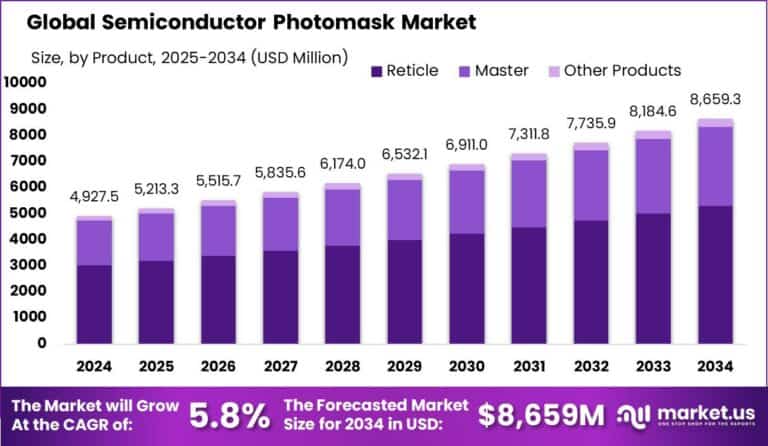
The semiconductor photomask market is a crucial segment of the global semiconductor industry, serving as the backbone for the development and manufacturing of microchips and integrated circuits. Photomasks are precision tools that contain microscopic images of electronic circuits, used in photolithography to transfer patterns onto semiconductor wafers. As the demand for smaller, faster, and more efficient electronic devices continues to rise, the importance of photomasks in the semiconductor manufacturing process becomes increasingly significant. The Global Semiconductor Photomask Market size is expected to be worth around USD 8,659 Mn By 2034, from USD 4927.5 Mn in 2024, growing at a CAGR of 5.80% during the forecast period from 2025 to 2034.
Growth Factors
The growth of the semiconductor photomask market can be attributed to several key factors. First, the continual advancement in technology necessitates the development of more complex and smaller chip designs, which in turn requires high-precision photomasks. Additionally, the expansion of consumer electronics, particularly smartphones, tablets, and other portable devices, drives the demand for semiconductor chips and subsequently for photomasks. Another significant growth factor is the rise in applications of Internet of Things (IoT) technologies, which demand more semiconductor content per device.
Read More @https://market.us/report/semiconductor-photomask-market/
Emerging Trends
Emerging trends in the semiconductor photomask market include the adoption of extreme ultraviolet (EUV) lithography, which allows for even smaller feature sizes and more complex circuits on a single chip. This technology represents a major shift in photomask manufacturing and is set to redefine the standards of chip performance and miniaturization. Furthermore, advancements in mask inspection technologies and the development of multi-layer masks are also trending, as they significantly reduce the time and cost associated with photomask production.
Top Use Cases
Key use cases of semiconductor photomasks include their application in high-performance computing devices, where they enable the development of powerful processors and memory chips. They are also extensively used in the production of consumer electronics and in automotive applications, where reliability and efficiency are critical. Additionally, photomasks are indispensable in the manufacturing of sensors and cameras, particularly for advanced driver-assistance systems (ADAS) and smartphones.
Challenges
The semiconductor photomask market faces several challenges, including high production costs due to the complexity and precision required in photomask manufacturing. The need for constant innovation to keep up with rapidly changing technology also poses a significant challenge, as does ensuring the quality and accuracy of masks given the ever-decreasing size of semiconductor components. Furthermore, the susceptibility of the market to global economic fluctuations can affect investment and growth.
Opportunities
Opportunities in the semiconductor photomask market are abundant, particularly in areas involving the development of new materials and technologies that can enhance the performance and reduce the costs of photomasks. There is also significant potential in expanding into emerging markets where semiconductor manufacturing is growing. Additionally, partnerships with semiconductor foundries and equipment manufacturers can provide new avenues for growth and innovation.
Conclusion
In conclusion, the semiconductor photomask market is positioned at a critical juncture, where the demands of modern technology drive its growth and necessitate continuous innovation. While there are challenges to overcome, particularly in terms of cost and technological advancement, the opportunities available in this dynamic market are vast. As electronic devices become increasingly central to our daily lives, the market for semiconductor photomasks is expected to remain robust, underpinning the broader trends of the semiconductor industry and fueling the development of the next generation of electronic devices.
Comments
Post a Comment