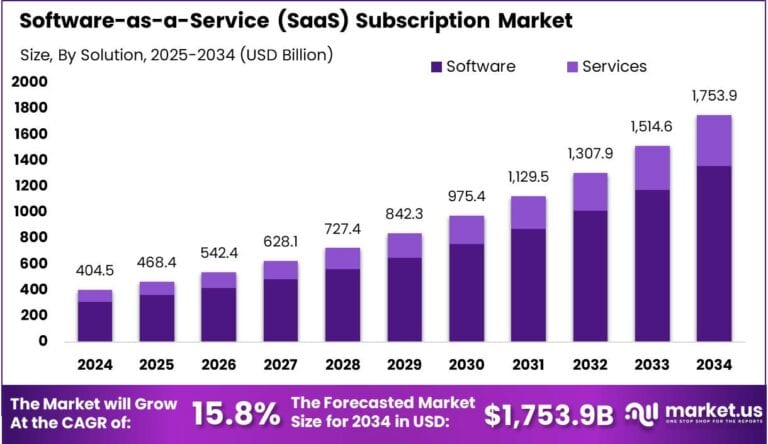
The Software-as-a-Service (SaaS) subscription market has significantly reshaped the landscape of digital business models. This model allows businesses to access software via the internet, paying a recurring subscription fee rather than purchasing a license outright. SaaS solutions offer a range of applications from enterprise resource planning (ERP) to customer relationship management (CRM) tools, serving a broad spectrum of industries. The Software-as-a-Service Subscription Market size is expected to be worth around USD 1,753.9 Bn By 2034, from USD 404.5 Bn in 2024, growing at a CAGR of 15.80% during the forecast period from 2025 to 2034. In 2024, North America led the SaaS Subscription Market, holding over 37.2% share, with revenue around USD 150 bn.
Growth Factors
The growth of the SaaS subscription market can be attributed to several key factors. Firstly, the flexibility and scalability of SaaS solutions meet the evolving needs of modern businesses, allowing them to adapt quickly to changes in market conditions and business size. Additionally, the cost-effectiveness of SaaS platforms, which eliminate the need for substantial upfront hardware investments and ongoing maintenance, makes them highly attractive. The widespread increase in cloud adoption across industries also fuels this market's expansion.
Read More @https://market.us/report/software-as-a-service-subscription-market/
Emerging Trends
Emerging trends in the SaaS subscription market include the increasing integration of artificial intelligence (AI) and machine learning (ML), which enhance the functionality and efficiency of SaaS applications. Another trend is the growing emphasis on cybersecurity within SaaS platforms, driven by the escalating threats in the digital space. Furthermore, vertical SaaS, which offers customized solutions tailored to specific industries, is gaining traction, providing more specialized tools and analytics.
Top Use Cases
Top use cases of SaaS include CRM systems that help businesses manage and analyze customer interactions, HR management systems that streamline hiring and employee management processes, and financial management systems that provide real-time insights into business finances. Additionally, project management tools and collaboration platforms have become essential, especially with the rise of remote working environments.
Challenges
Despite its benefits, the SaaS subscription market faces several challenges. Data security concerns are paramount as businesses must trust providers to safeguard sensitive information. Additionally, the dependency on internet connectivity can be a limitation in regions with unreliable internet services. Moreover, companies might face issues with vendor lock-in, making it difficult to switch providers due to proprietary technologies.
Opportunities
The SaaS subscription market presents numerous opportunities, particularly in developing markets where businesses are leapfrogging traditional IT infrastructure to adopt cloud-based solutions. There is also potential for growth in offering more industry-specific solutions, which could further drive the adoption of SaaS products. Moreover, expanding into emerging technologies like blockchain and enhanced analytics could provide new streams of revenue and innovation.
Conclusion
In conclusion, the SaaS subscription market is poised for continued growth, driven by technological advancements and the increasing need for flexible, scalable business solutions. While challenges such as data security and vendor lock-in exist, the opportunities presented by emerging markets and technologies likely outweigh these obstacles. As companies continue to embrace digital transformation, SaaS solutions will play a critical role in shaping the future of global business practices.
Comments
Post a Comment