Key Market Insights
In 2022, the generative ai market size accounted for USD 10.6 billion. Between 2023 and 2032, this market is estimated to register the highest CAGR of 31.4%. It is expected to reach USD 151.9 billion by 2032.The explosive growth of this market can be attributed to its widespread adoption across industries, such as media and entertainment, BFSI, IT/telecom, healthcare and automotive/transportation.
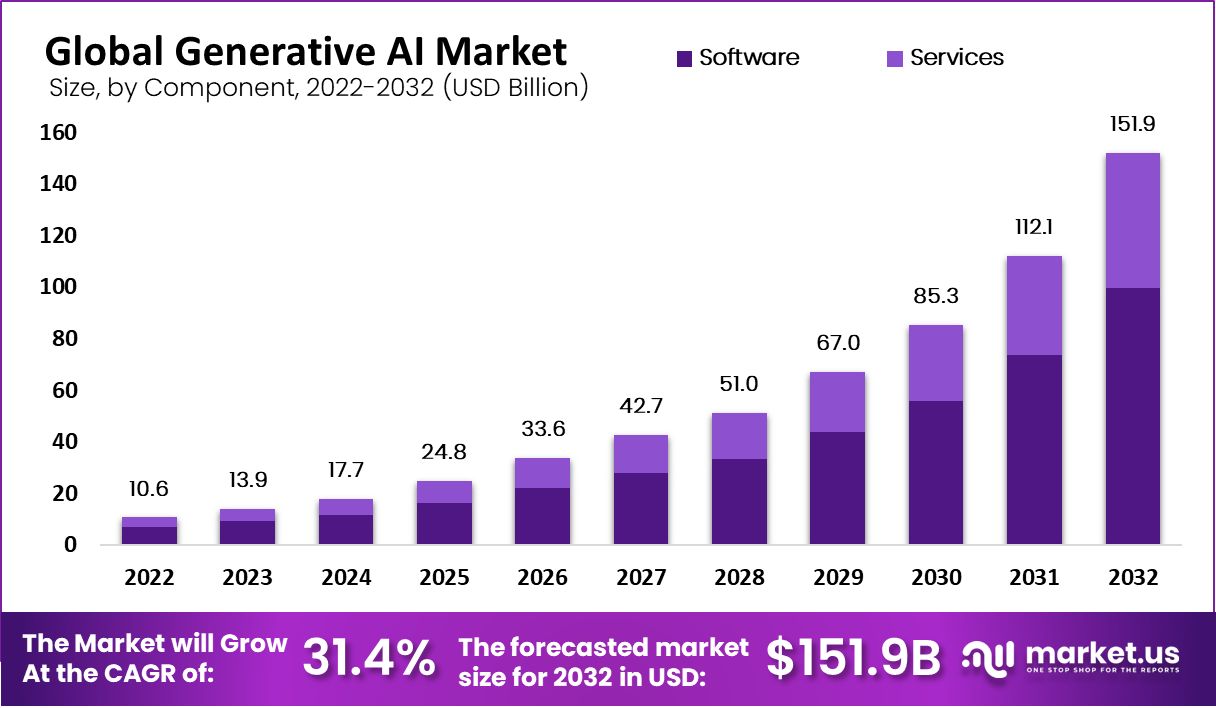
Generative AI is an artificial intelligence technique capable of creating novel content such as texts, images, music or code. Trained on large datasets of existing material, Generative AI technologies have the potential to transform many industries.
For more insights: https://market.us/report/generative-ai-market/
Trends in Generative AI Market
The market for generative AI is rapidly developing, and several trends are shaping its future development.
One trend is the increase in industry-specific applications of AI. Generative AI models are now being designed for use across numerous industries such as healthcare, finance, manufacturing and retail - leading to more tailored generative AI solutions able to meet specific industry needs.
One trend to watch for in generative AI technology is its increasing adoption via cloud services, making access and use easier for businesses without needing to invest in their own hardware and software infrastructure - thus making generative AI accessible to more businesses and organizations.
Securing open-source generative AI resources and tools has also become more prevalent, making it easier for people to develop and experiment with this field, hastening innovation in this area.
Impact of COVID-19
The COVID-19 pandemic has had an enormous influence on the market for generative AI technologies. On one hand, its spread has led to rapid adoption by specific industries such as healthcare and online retail; such as AI being used to develop drugs or vaccines while on another creating tailored shopping experiences for customers.
On the other hand, pandemic has also caused delays in the adoption of generative AI technologies in other industries, including travel and tourism. Demand for content creation tools powered by generative AI-powered content production tools has declined due to reduced travel and tourism activities.
Overall, COVID-19's effects on the market for generative AI technologies is mixed. While the pandemic may have increased adoption of these technologies in certain industries, others have experienced decreased adoption due to COVID.
Key Insights
The media and entertainment sector was the leader in adopting generative AI in 2022, accounting for 31% of global market revenue. Generative AI technology is being employed here to produce realistic yet engaging digital content such as videos, music tracks, images or any combination thereof.
The BFSI industry is another strong advocate for Generative AI, accounting for 20% of global market revenue in 2022. Generative AI technology is being employed within this sector to increase fraud detection, risk analysis, and customer service delivery.
IT and telecom sectors are leading adopters of generative AI, making up over 15% of total market revenue in 2022. Generative AI technology is employed in these industries to automate network optimization, develop new products/services, and enhance customer experiences.
Healthcare is one of the key areas where generative AI adoption has increased dramatically; accounting for over 10% of global market revenue by 2022. Generative AI technology is being utilized by this sector to develop new drugs and therapies, enhance medical diagnoses and personalize patient care services.
Automotive and transportation industries have emerged as early adopters of generative AI, accounting for more than five percent of total market revenue by 2022. Generative AI technology is being utilized in these sectors to design vehicles, create autonomous driving systems, and enhance traffic management practices.
Recent Developments
Investment in generative AI startups has experienced a substantial surge. Over USD 1 billion was invested into such startups between 2021-2022 - more than double than was invested previously.
Major technology companies, like Google, Microsoft and Amazon are making substantial investments in generative AI. By developing tools and services for this emerging sector, these major players are helping drive its expansion in the market.
Generative AI companies and other industries are increasingly joining forces. Pharmaceutical firms have used AI services from generative AI providers to research new medications and therapies.
Opportunities
The generative AI market presents businesses of all sizes with many opportunities. Here are just a few examples:
Generative AI can be leveraged to produce cutting-edge products and services. For example, it could create synthetic videos, music tracks and images suitable for use within industries like media & entertainment, BFSI and IT & telecom.
Generative AI can be leveraged to increase the efficiency and effectiveness of business processes, automating tasks such as fraud detection, risk evaluation and customer support.
Generative AI can be leveraged to tailor customer experiences and offer more relevant recommendations based on individual tastes and needs.
Challenges
Generative AI holds enormous potential to revolutionize numerous industries; however, some hurdles must first be cleared away for it to reach its full potential.
One of the greatest obstacles associated with the use of generative AI is creating ethical guidelines. Since generative AI could potentially produce content that is harmful or misleading, it's essential that guidelines exist so it's used responsibly.
Another challenge lies in gathering more data. Generative AI models require large datasets for training purposes; therefore, the more we have available to us, the better these models will perform. However, collecting and curating large datasets may be costly and time consuming processes.
Restraints
Alongside these challenges are other constraints which could impede growth in the market for generative AI products.
One barrier is the high cost associated with developing and deploying generative AI models. Training one requires expensive computing resources, while integration may prove problematic with existing systems.
One major challenge associated with generative AI models is their development and deployment requires specific knowledge that may not yet be readily available - meaning there is a shortage of qualified workers in this field.
Regulators also express some reservations regarding the use of generative AI. They worry that its misuse may create deep fakes or spread misinformation.
Key Market Segments
Based on Component
Services
Software
Based on Technology
Generative Adversarial Networks (GANs)
Transformer
Variational Auto-encoder (VAE)
Diffusion Networks
Based on End-User
Media & Entertainment
BFSI
IT & Telecommunication
Healthcare
Automotive & Transportation
Other End-Users
Market Key Players:
Listed below are some of the most prominent generative AI market industry players.
IBM Corporation
Genie AI Ltd.
MOSTLY AI Inc.
Google LLC
D-ID
Amazon Web Services Inc.
Microsoft Corporation
Adobe Inc.
Synthesia
Other Key Player
Contact
Global Business Development Team: Market.us
Market.us (Powered By Prudour Pvt. Ltd.)
Send Email: inquiry@market.us
Address: 420 Lexington Avenue, Suite 300 New York City, NY 10170, United States
Tel: +1 718 618 4351, +91 78878 22626
Website:https://market.us/
Blog: https://techmarketreports.com/
Comments
Post a Comment