Introduction:
Federated learning (FL) is a machine learning technique used to train a shared model on multiple devices without exchanging their data. Instead, each device trains the model on its local data and shares only any updates to model parameters with the central server; then this central server aggregates updates from all devices and develops a global model before sending back updates back out for another round of training on all of these devices.
FL offers several advantages over traditional centralized machine learning approaches. First, it protects user privacy by keeping data on devices instead of being sent centrally for processing. Second, FL can be used to train models on large and distributed datasets that would otherwise be difficult or impossible to centralize; finally it allows training models on heterogeneous datasets gathered from multiple devices with different types of information.
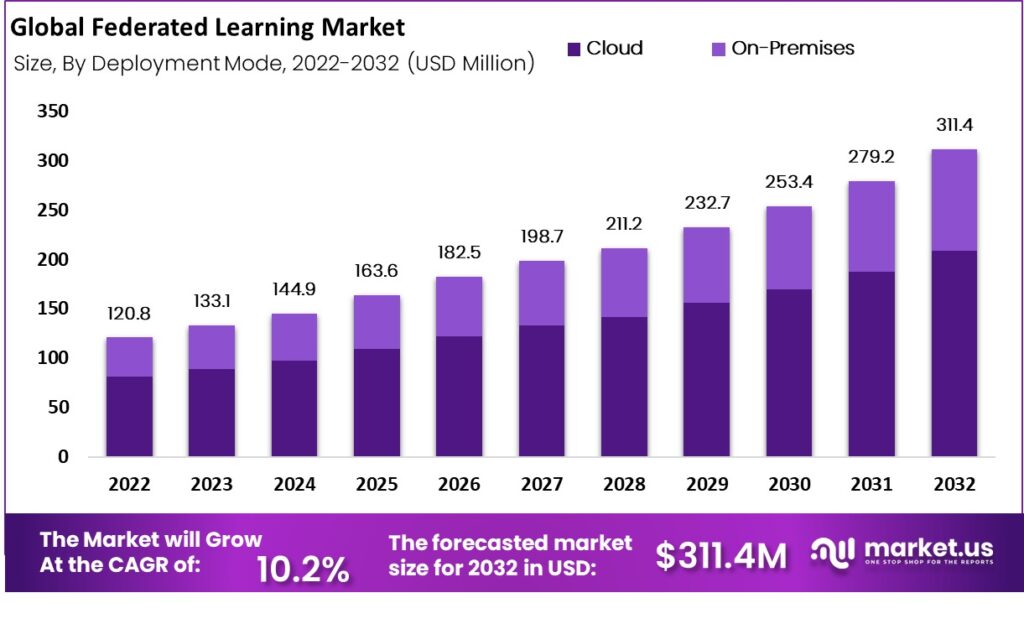
The Federated Learning Market was valued at USD 120.8 million in 2022. It’s predicted to increase and become worth USD 311.4 million by 2032. The growth rate from 2022 to 2032 is estimated at 10.2% CAGR.
Below are top 10 Federated learning market:
1. Acuratio, Inc :
Acuratio, Inc. is an innovative technology company focused on healthcare and artificial intelligence (AI). Their primary mission is creating AI-powered solutions that improve medical diagnosis and treatment processes; using machine learning algorithms to analyze vast amounts of medical data like images, patient records, lab results etc for accurate disease detection. Their innovations could revolutionize healthcare delivery by providing faster diagnosis with greater precision; saving lives while simultaneously cutting costs - the transformative potential of AI is clear here! Acuratio's commitment to healthcare AI underscores this potential.
2. Apheresis AI GmbH :
Apheresis AI GmbH stands at the forefront of AI in medical technology. Their speciality lies in blood component separation through apheresis and they employ advanced machine learning algorithms to optimize this medical procedure. By harnessing AI, Apheresis AI strives to increase efficiency of blood component extraction while improving patient outcomes - potentially revolutionizing this field with their innovations that make apheresis safer and more effective across various medical applications.
3. Cloudera, Inc.:
Cloudera is an innovative American software company that specializes in big data analytics and management. Their comprehensive platform for data management and analysis offers organizations a means of efficiently handling vast quantities of information. Their solutions leverage open-source technologies like Hadoop to gain insight from data, enhance decision-making processes and drive innovation within organizations utilizing its solutions - thus becoming key players within the big data ecosystem.
4. Google LLC :
Google LLC, a subsidiary of Alphabet Inc., is an international technology giant known for its internet-related products and services. Their impressive range includes the world's most popular search engine, cloud computing services, the Android operating system, software applications, hardware products and artificial intelligence research - integrating these technologies into its products for enhanced user experiences such as more personalized searches or computer vision detection - playing an instrumental role in furthering AI research worldwide.
5. Enveil:
Enveil: Enveil is a cybersecurity firm specializing in homomorphic encryption technology. Their innovative solutions enable data to be processed and analyzed while remaining encrypted - offering significant gains to data security and privacy. Enveil's solutions have proved particularly valuable to organizations handling sensitive or confidential information such as financial institutions, healthcare providers and government agencies that must comply with stringent data protection regulations.
6. Edge Delta Inc.:
Edge Delta Inc. specializes in optimizing and speeding up machine learning operations at the edge of networks. Their solutions allow real-time data processing and model inference on edge devices for reduced latency and bandwidth use - ideal for applications like edge computing, IoT (Internet of Things), autonomous systems and similar scenarios where quick decision making is essential. Their innovations enable organizations to use AI without depending on cloud infrastructure - particularly useful when network connectivity or latency requirements are limited or stringent.
7. FedML:
Federated Machine Learning, or FedML for short, is an area of AI research and development specialized in collaborative machine learning models. FedML entails training these models across various decentralized data sources while protecting privacy. FedML has become widely adopted due to its potential to address privacy concerns and data sharing restrictions imposed upon organizations by regulations; by enabling organizations to collaborate without sharing sensitive data for training AI models without sharing sensitive data directly between organizations collaborating, FedML facilitates advancements across several domains including healthcare, finance, recommendation systems etc; it plays an essential part of creating privacy-sensitive AI technologies.
8. IBM Corporation:
As one of the world's premier technology companies, IBM Corporation boasts an illustrious legacy in numerous areas - AI included. Their AI division specializes in creating powerful solutions that assist businesses and governments make data-driven decisions using powerful solutions like their Watson platform for natural language processing, machine learning and data analytics. Their innovations can be found everywhere from healthcare, finance and customer service industries; with commitments towards both research advancement and practical applications demonstrating its significant influence within this field.
9. Nvidia Corporation:
Nvidia is a renowned global technology company known for their graphics processing units (GPUs) and their applications in artificial intelligence and deep learning. Nvidia GPUs play an essential role in speeding AI workloads, including training complex neural networks and powering high-performance computing tasks. Their GPUs have strong presences within gaming, data centers, supercomputers and AI research. Their dedication to advancement of GPU technology has had a substantial effect on AI and machine learning fields alike; creating more powerful and efficient AI models than ever before.
10. Intel Corporation:
Intel is a multinational technology company known for its semiconductor manufacturing and innovation. Intel has made significant strides in artificial intelligence (AI), making major contributions in developing high-performance CPUs and AI hardware accelerators that are essential components in AI infrastructure that supports training and inference tasks. Intel's commitment to improving AI hardware helps ensure solutions become more accessible while handling complex workloads more easily - their technologies are integrated into various devices from personal computers to data center servers supporting various industries across different sectors.
Suggested reading:
Global Federated Learning Market By Deployment (Cloud and On-Premises), By Applications (Industrial Internet of Things, Data Privacy Management, Drug Discovery, Augmented and Virtual Reality, Risk Management, and Other Applications), By Industry Vertical, By Region and Companies - Industry Segment Outlook, Market Assessment, Competition Scenario, Trends, and Forecast 2023-2032
Recent development :
Google AI Debuts Federated Learning Platform for Mobile Developers: Google AI unveiled their federated learning platform ML Kit for Firebase to allow mobile developers to train and deploy federated learning models without writing custom code for Android and iOS apps.
Microsoft Announces Federated Learning Toolkit for Azure: Microsoft recently unveiled their federated learning toolkit for Azure called Azure Federated Learning, providing developers with all of the tools required for training and deploying federated learning models on Azure.
IBM Unveils Federated Learning Solution for Healthcare: IBM has unveiled their Watson Health Federated Learning solution, enabling healthcare organizations to train federated learning models on their own data without sharing it with IBM.
Amazon Web Services Announces Federated Learning Service: Amazon Web Services (AWS) announced a federated learning service called Amazon SageMaker Federated Learning to allow developers to train and deploy federated learning models on AWS without needing to write custom code.
Nvidia Unveils Federated Learning Library for GPUs: Nvidia recently unveiled its Federated Learning Library for GPUs, providing developers with all of the tools required for training and deploying federated learning models on Nvidia GPUs.
Comments
Post a Comment